Watering System Without A Tap Uk
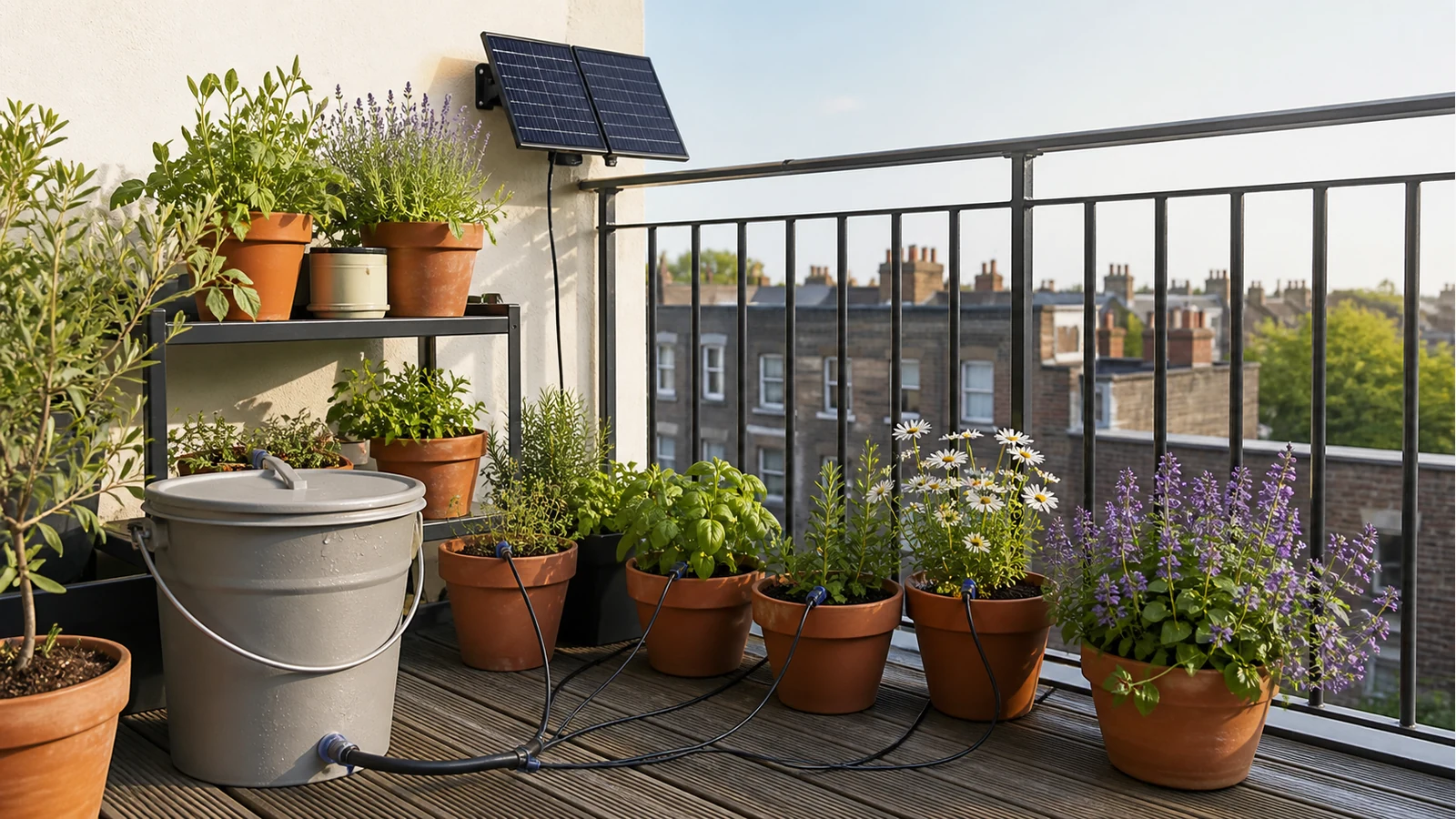
Direct answer: the most practical watering system without a tap in the UK is usually a reservoir-fed pump kit: a bucket, water container or water butt supplies the water, a small pump moves it through microtubing, and drippers feed each pot. That avoids an outdoor tap, avoids fixed plumbing, and keeps the setup reversible for balconies and rented flats.
This is not the right route for every garden. If you need to water a lawn, a long border, or a high-pressure spray system, a tap-fed installation is still the normal path. But for balcony pots, terrace containers and small greenhouse groups, tapless watering solves the main human problem: remembering to carry water at the exact time the compost is drying out.
Start with the water source
For a flat or balcony, the water source is usually a lidded bucket, storage box, decorative reservoir or small water butt. UK retailers sell solar watering kits that draw from a standalone container rather than a wall tap, as shown in Easy Garden Irrigation's tapless solar watering listing. Gardena also publishes advice on watering balcony plants without a tap, which is useful because it treats the no-tap constraint as the starting point, not an afterthought.
Choose a container you can fill safely from indoors and move without straining. A bigger container gives more buffer, but a container that is too heavy to refill becomes a new chore. Keep it shaded where possible, covered against debris, and low enough that a pump intake can sit securely near the bottom without pulling in sediment.
Compare the realistic options
| Option | Best fit | Main limitation |
|---|---|---|
| Solar pump drip kit | Multiple pots where there is no outdoor tap or socket | Needs a suitable panel position and a tested reservoir size |
| Watering spikes or cones | One or two small pots over short absences | Uneven delivery and limited reserve |
| Indoor tap connector | Temporary supervised use where a hose can pass safely | Awkward in flats and not a leave-alone solution |
| Self-watering pots | Plants you are willing to repot | Does not help existing mixed containers immediately |
Balcony constraints that matter in the UK
The usual friction points are not technical buzzwords. They are simple: no outside tap, no outside socket, limited railing space, wind exposure, and a landlord or building rule that makes drilling undesirable. Treat the installation as temporary. Clip or weight the solar panel rather than fixing it permanently, route tubing along edges, and avoid trip hazards near the door.
North-facing or shaded balconies need caution. A solar kit may still be useful, but do not assume every cloudy week will behave like a bright June weekend. Test the system at home before relying on it while away. If the panel cannot see usable light for part of the day, reduce the number of pots on the system or choose a kit with an appropriate battery buffer after checking the seller's specification.
Setup checklist before you trust it
- Group pots with similar water needs first, rather than mixing herbs, tomatoes and succulents on one line.
- Fill the reservoir, run a full cycle, and check the last dripper by hand.
- Lift tubing off sharp balcony edges and secure loose runs against wind.
- Leave the system running overnight while you are home, then inspect puddles, dry pots and the remaining water level.
- Keep a manual watering can available; automation reduces routine work, it does not remove observation.
Who should pause before buying
Do not buy a tapless balcony system if your real job is lawn irrigation, if the containers sit in deep shade all day, or if you need guaranteed watering for valuable plants without first testing the setup. It is also a poor fit for households that cannot safely store a water container on the balcony.
If your problem is daily forgetfulness or a short holiday, continue with a compact reservoir-fed layout. If your main problem is a greenhouse or water butt rather than a flat balcony, compare solar greenhouse watering or rainwater butt automatic watering kits next.
FAQ
Can I use a watering system without a tap in a rented flat?
Usually yes if it is freestanding and reversible, but check lease and building rules before placing water containers or fixings on a balcony.
Does it need mains electricity?
Many tapless systems use solar power or batteries, but the exact behaviour depends on the kit. Confirm the specification and test it in your actual light conditions.